


Introduction
Continuing with this week's theme of decision making techniques, today I wanted to discuss the Highsmith Decision Spectrum. In the dynamic world of agile development, making timely and effective decisions is crucial. The Highsmith Decision Spectrum, a framework developed by Jim Highsmith, provides a valuable tool for guiding decision-making in agile teams.
Understanding the Spectrum
The Highsmith Decision Spectrum categorizes decisions into four levels of authority:
- Team: Decisions that can be made by the development team itself, without significant input from higher-level management.
- Program: Decisions that require input from program management or other stakeholders, but can be made by the team with their approval.
- Portfolio: Decisions that impact multiple projects or programs, and require input from portfolio management.
- Enterprise: Decisions that have a significant impact on the entire organization and require approval from executive leadership.
How the Highsmith Decision Spectrum Works
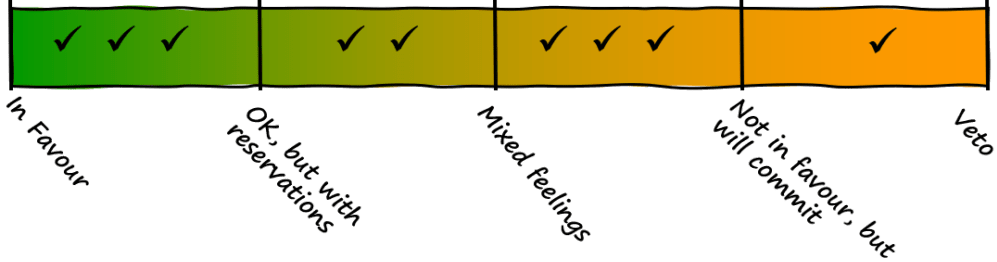
A Highsmith Decision Spectrum will generally have 4 sections, including:
- In Favour
- OK, but with reservations
- Mixed feelings
- Not in favour, but will commit
- Veto
Team members are asked to indicate with a mark, where they are on the topic that is being discussed. The spectrum ranges from "In Favour" or a strong vote for yes, to "Veto" or a strong vote for no. This allows team members to register their concerns while keeping everyone engaged. The goal is to find an approach that everyone can feel comfortable enough with that they are willing to commit.
Applying the Spectrum in Agile
By understanding the Highsmith Decision Spectrum, agile teams can:
- Empower Teams: Empower teams to make decisions at the team level, fostering a sense of ownership and accountability.
- Optimize Decision-Making: Ensure that decisions are made at the appropriate level, avoiding unnecessary bureaucracy and delays.
- Improve Collaboration: Encourage collaboration between team members and stakeholders to make informed decisions.
- Reduce Risk: Identify and mitigate risks by involving the right people in the decision-making process.
Tips for Effective Decision-Making
- Clear Communication: Ensure that everyone involved in the decision-making process understands the context, goals, and constraints.
- Shared Understanding: Foster a shared understanding of the problem or opportunity and the potential solutions.
- Data-Driven Decisions: Use data and metrics to inform decision-making.
- Iterative Approach: Break down complex decisions into smaller, more manageable steps.
- Continuous Improvement: Regularly review and refine the decision-making process.
Summary
By leveraging the Highsmith Decision Spectrum, agile teams can have yet another tool in their toolbox that can help them make more informed, timely, and effective decisions, ultimately leading to better outcomes.