


Introduction
Carrying on with this week's theme of decision making techniques, today I'd like to discuss the Pareto Analysis. I briefly mentioned this technique in my post titled Root Cause Analysis: Uncovering the Underlying Issues. Today I will be digging into this technique in more detail.
Pareto analysis, also known as the 80/20 rule, is a valuable technique for prioritizing tasks and identifying areas for improvement. It helps teams focus on the most impactful activities, leading to increased efficiency and productivity.
What is Pareto Analysis?
Pareto analysis is based on the principle that 80% of the effects come from 20% of the causes. In the context of agile, this means that a small number of tasks or issues often contribute to the majority of the problems or benefits.
How to Apply Pareto Analysis in Agile
- Identify the Problem: Clearly define the problem or issue that needs to be addressed.
- Collect Data: Gather data on the frequency or impact of different causes or factors contributing to the problem.
- Analyze the Data: Sort the data in descending order of frequency or impact.
-
Create a Pareto Chart: A Pareto chart is a bar graph that visually represents the data, with the bars arranged in descending order of frequency or impact. Each bar will represent an individual factor. An example is below:
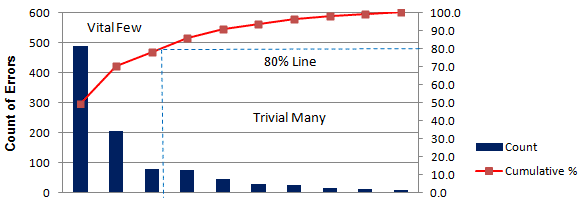
- Identify the Vital Few: Focus on the few critical factors that contribute to the majority of the problem.
- Take Action: Develop and implement strategies to address the identified root causes.
Benefits of Pareto Analysis in Agile
- Improved Prioritization: By identifying the most impactful tasks, teams can focus their efforts on what matters most.
- Increased Efficiency: By addressing the root causes of problems, teams can improve their overall efficiency and productivity.
- Better Decision Making: Pareto analysis can help teams make data-driven decisions and avoid wasting time on low-impact activities.
- Enhanced Problem-Solving: By breaking down complex problems into smaller, more manageable components, teams can develop effective solutions.
Real-World Applications of Pareto Analysis in Agile
- Backlog Prioritization: Identify the most valuable features or user stories to prioritize in the product backlog.
- Defect Triage: Determine which defects have the greatest impact on the system and prioritize them for fixing.
- Process Improvement: Identify the most significant bottlenecks or inefficiencies in a process and focus on improvement efforts.
- Risk Management: Prioritize risks based on their potential impact and likelihood of occurrence.
Summary
By incorporating Pareto analysis into their agile practices, teams can easily identify what issues to focus on, helping them make better decisions, improve their efficiency, and deliver higher-quality products and services.